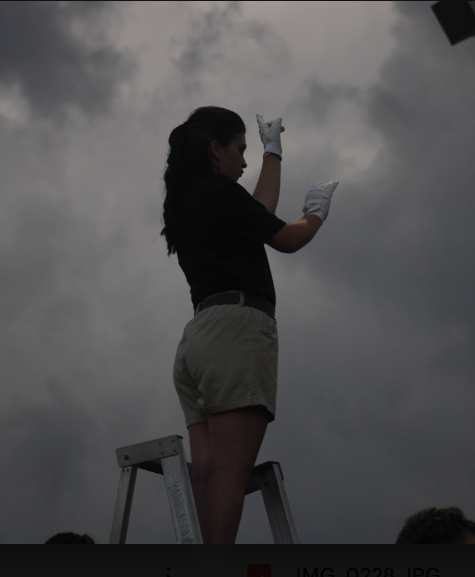
Abby Holm (12) once stood at the front of the band as drum major at Lenoir City High School, leading rehearsals, conducting performances and helping guide younger members of the ensemble. While the title often sounds glamorous from the outside, Holm said the reality of the job involved far more responsibility than most people realize. Reflecting on that period of her life, she described an experience that helped her grow as a leader and eventually guided her toward rediscovering the kind of performing that brings her the most joy.
“Honestly, my experience in such an important role wasn’t as perfect as I had hoped. Being a drum major at LCHS isn’t just about conducting and helping freshmen make new friends, it is quite literally being an extension of the band directors. Being a drum major is like being Barbie with her two-thousand different careers. In the span of 3 months I was a teacher, a therapist, an instrument repairman, a nurse, a babysitter, a conductor, and a student. On top of trying to learn my own music, I was also teaching my assistant drum major, dealing with student drama, leading the flute section, among many other responsibilities. While I am wholeheartedly proud of the ensemble and grateful for the experience I had, I can’t help but reflect on the lack of sense of self I was experiencing. It seemed that my entire personality had become the fact that I was drum major, because that’s what consumed all of my time and energy. When I wasn’t sleeping, I was practicing conducting, giving private lessons, attending leadership meetings, going to conducting workshops, or in the band room leading rehearsals. While I think I had a positive impact on the ensemble as a whole, being pushed to the point of being consumed with something I’m not passionate about really caused me a lot of pressure and stress,” Holm said.
As the school year went on, Holm said one of the most challenging parts of the role was feeling responsible for setting the tone for the entire ensemble. Maintaining confidence and enthusiasm for others became an important part of leadership, even during moments when she was still learning how to navigate those expectations herself.
“I think the most challenging part of the role was trying to put up the front of ‘I’m so passionate about this’ in front of the ensemble. While yes, there was a time in my high school career where I was extremely passionate about playing flute and conducting, constant feedback and criticism over time caused that spark to dwindle. Although I expressed these feelings behind closed doors, it was still important for me to present a positive attitude so it wouldn’t affect the rest of the ensemble,” Holm said.
Despite the difficulties that sometimes came with leadership, Holm said the experience ultimately helped her develop a better understanding of balance and personal boundaries.
“It definitely taught me that boundaries are important. Even though passion may drive my love for something, I should not let it consume every aspect of my day. It also helped me recognize habits that I needed to work on changing so I could develop a healthier balance moving forward,” Holm said.
The experience also shaped the way Holm thinks about feedback and communication in music. Over time, she began to recognize how the way criticism is delivered can influence confidence, growth and the way musicians view themselves.
“I have learned that there is in fact a difference in making a critique on someone’s playing to make them a better musician versus letting criticism become too personal. There’s such a difference between ‘I’m being lazy, do it better’ and ‘I’m going to try to get quieter when you play the A# in measure 5’. Being able to separate the person from the music, even in the context of personal practice time, is something that I definitely have learned to work on,” Holm said.
Looking back now, Holm said the experience also taught her the importance of confidence and self-reflection as a performer and leader.
“It definitely caused me to have a lot of issues with self esteem, as well as impacting the way I view myself as a musician and a leader. After taking some time away from the program, my self confidence has definitely taken a turn for the better, but it took a lot of self work for me to get to that point,” Holm said.
Even so, Holm said many of the skills she developed during that time have continued to help her in new areas of performing—especially in theatre, where she has found a renewed sense of excitement and creativity.
“I developed a lot of positive habits that I’ve been able to translate over into doing theatre. Something that’s really impacted my thought process was changing a negative internal feeling into a positive thought. The adrenaline rush you get when you’re nervous is the exact same feeling you get when you’re excited, so saying out loud ‘I’m so excited’ when I’m getting those nervous butterflies helps to change the feeling from a negative feeling to a positive one. This tactic would help me prep myself before halftime or competitions all the time,” Holm said.
Over time, Holm said she began to realize that it might be the right moment to return to an activity that had always brought her joy.
“There was a moment at the ‘Panther Palooza’ event we had at the beginning of the year where I was just really mentally exhausted. I remember trying to conduct the fight song and just feeling a weight of ‘why am I still doing this’ start to settle in my stomach. That’s sort of when I knew that my purpose for the program had been served and it was time for me to part ways and return to something that I truly enjoyed,” Holm said.
That realization led Holm back to something that had been part of her life since childhood. Theatre, which she had grown up around because of her father’s involvement in performing, offered her a creative space where she could reconnect with her love of performing.
“I’ve been doing theatre since I was like four years old. My dad used to act in big shows all the time and it was just something I had grown up around. Theatre is something that I still enjoy even when I’m not the best one in the room. I don’t get anxious taking risks onstage and I constantly crave the adrenaline rush I get from performing. I’ve always been comfortable with being in front of a crowd, and having previous theatre experience helped a lot when it came to conducting as drum major,” Holm said.
Returning to theatre also allowed Holm to experience learning in a new way. Instead of focusing on leadership responsibilities, she was able to spend more time developing her own skills and rediscovering what she loved about performing.
“It was definitely nice to be asking the questions instead of answering them all the time for a change. Jumping back into something I had taken a four year hiatus from definitely had some challenging moments, but having such a great teacher and community within the class definitely helped set me up for success,” Holm said.
Now, with some distance from that chapter of her life, Holm said the experience ultimately helped her rediscover what she enjoys most about performing. Theatre has given her the opportunity to reconnect with creativity, balance and some renewed passion for being on stage.
“It for sure changed the way I view a lot of things in the culture of music. It takes a lot of work to break bad habits to create new ones. It really helps having more free time to actually take time to learn what those things are and how I can work to become a better person and performer. I’ve also rediscovered that I can be my own person outside of my hobbies, which has just helped fan the flame that I rekindled for performing. Taking breaks and time for myself as well as building strong relationships has been one of the most beneficial things for me, which took a long time for me to learn,” Holm said.